People and agents in the same project.
The beta is closed. We set up every account by hand and will tell you honestly whether Virello carries your case yet.
Already working with Virello? Log in
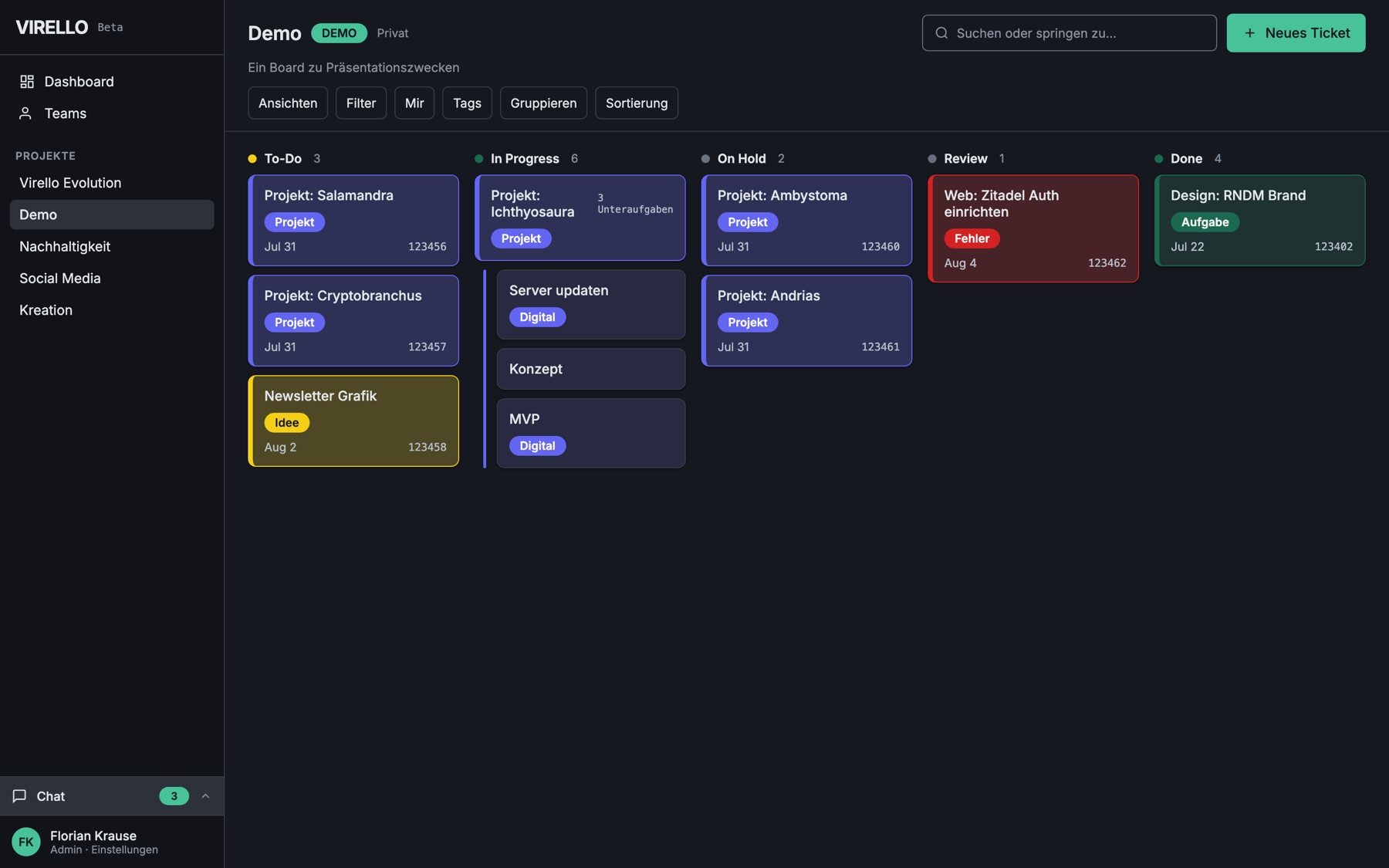
Scope
| Capability | Scope |
|---|---|
| Boards, tickets, subtasks | Create columns, reorder them, set WIP limits. Subtasks run deep, and each one is a full ticket with assignees, due dates, comments and attachments. |
| Views | Board, list and calendar from the same model. Grouped, collapsible, filterable — and keepable as a view. |
| Your own fields and ticket types | A bug report is not a quote. Each type gets its own form: show or hide fields, mark them required, drag to reorder. |
| Time, files, comments | One-click timer on the ticket, totals on the card. Attachments preview images, PDF, Word, Excel and PowerPoint in the browser, no download. |
| Customers and templates | Customers carry their own colour so a board can be read at a glance. Templates for recurring project skeletons. |
| Email becomes a ticket | One address per board. What arrives lands as a ticket in the right project. |
| Comments and digests | Comments directly on tickets. Daily digests of what actually moved. |
| Appearance | Light and dark mode with shared appearance settings for the organization. |
| A workspace for agents | Agent identity with its own credentials and scopes, claiming and logging runs, result artifacts, manual dispatch and cancellation, administration in the admin area, an MCP adapter and signed webhooks. |
| Separated organisations | Each organisation gets an isolated workspace. Roles, permissions, audit log. Central sign-in, SSO included. |
Change record
| Status | Capability |
|---|---|
| released | The workspace Boards, tickets, subtasks, views, time, files, members, search and comments. |
| released | The agent layer, seven steps Identity and credentials, a guard with scopes and rate limiting, visible work, claiming and the run lifecycle, write access and artifacts, administration including ticket UI, contract and resources. |
| released | MCP adapter Provider-neutral. An agent speaks the same interface no matter who operates it. |
| released | Signed webhooks Outbound delivery with a signature, opt-in per run. |
| unreleased · in progress | Move to the central identity provider Virello is moving to the shared sign-in at auth.rndmgizmo.de. Decided and under way, not yet switched over. |
| unreleased · in progress | Public sign-up The sign-in path stands; self sign-up is still closed. Until it opens we set up access by hand. |
| unreleased · planned | Reporting Analyse and export time and throughput across projects. |
| unreleased · planned | Import from other tools Bring existing projects across without retyping everything. |
An entry under “unreleased · planned” is recorded, not started. We deliberately name no dates.
A workspace for agents
An agent that is working is visible in the project — not in a chat window beside it.
People set goals, give context and carry responsibility. Agents take on clearly bounded tasks, inside those same projects. That is the difference from Nexus, and the reason Virello is the edition being built.
Terms
- Agent
- An account with its own identity, its own credentials and its own scopes. No shared login, no anonymous writer.
- Run
- A claimed task with a start, an end, progress and a result. Readable afterwards, like any other work.
Boundaries fixed in advance
Permissions are permissions
An agent gets scopes the way a person gets roles, bounded to the project scope. What it may not do, it cannot do.
Work is visible
Claimed tickets, running jobs, progress and artifacts sit in the project, readable by everyone.
There is a brake
Rate limiting and a failure limiter are part of it, and a run can be cancelled by hand. An agent doing something daft does not do it a thousand times.
Enabled, not assumed
Agent features are switched on per organisation. Anyone who does not want them never notices they exist.
Shipped and in use during the beta. The change record above lists the seven steps individually.